Specialists in the National Electricity Grid
The challenges posed by the dual energy and digital transition are profoundly transforming the electricity sector. Terna, in collaboration with the Polytechnics of Bari, Milan and Turin, has developed the Level II University Master’s programme in “Innovation in Electric Energy Systems”. “Poliba Chronicle” interviewed Massimo La Scala, lecturer at the Polytechnic University of Bari and the programme’s scientific coordinator.
15 July 2026
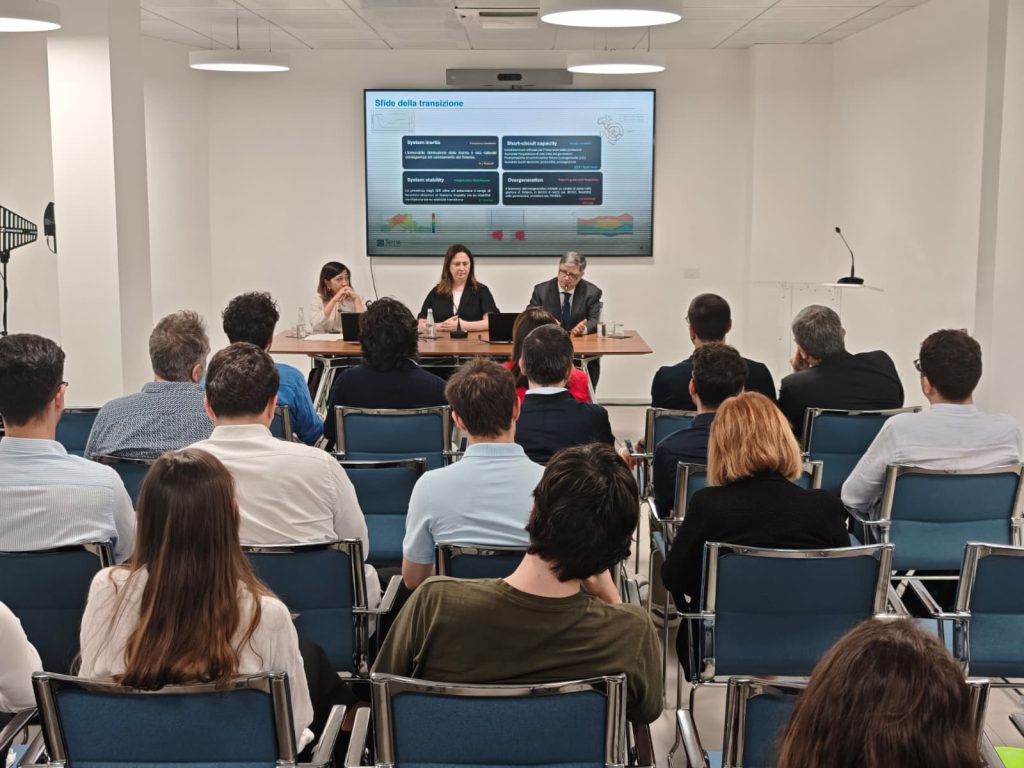
On June 9, the second edition of the second-level Master’s programme, “Innovation in Electrical Energy Systems,” was presented at the Politecnico di Bari. This national Master’s programme is supported and funded by Terna SpA, with the participation and academic and scientific support of Italy’s three polytechnic universities in Bari, Milan and Turin (PoliTechLab). Subsequently, on 16 June and 2 July, the initiative was presented at the Polytechnics of Milan and Turin.
Prof. Massimo La Scala is the scientific coordinator of the Master’s programme at the Bari Polytechnic. “Poliba Chronicle”, Poliba’s official magazine, interviewed him.
Professor the topic of energy is increasingly relevant and essential. Why are research, education and continuing professional development becoming indispensable?
The energy transition is one of the most important and strategic challenges of our time. Growing energy demand, the need to accelerate decarbonisation, the integration of renewable sources and the development of increasingly smart and digitalised electricity grids are profoundly transforming the energy sector, making new skills and highly qualified professionals indispensable.
In this context, research, education and continuing professional development are fundamental tools for facilitating change and meeting the needs of a constantly evolving market. This understanding gave rise to the second edition of the Level II University Master’s programme in “Innovation in Electric Energy Systems”, an advanced training course designed to prepare professionals capable of addressing the technological, environmental and industrial challenges of the future. Terna developed the Master’s programme as part of the network of the three Polytechnics of Bari, Milan and Turin to foster new specialist skills for the energy and digital transition.

The Master’s programme is an invitation, but also a highly career-oriented opportunity with employment prospects for graduates. Why?
The Master’s programme is intended for graduates with a master’s degree who wish to acquire specialist skills that can be put to immediate use in the world of work. It is not merely an opportunity for academic study, but a truly career-oriented programme that combines a solid scientific foundation with practical applications. Through lectures, laboratory activities and exchanges with industry experts, participants will develop advanced skills in the design, management and innovation of electric energy systems.
At the end of the Master’s programme, participants will receive a Master’s degree awarded jointly by the three polytechnic universities and will be able to work in the electricity sector as: Plant Engineer (expert in plants and technologies); Asset Manager (expert in asset management); Power Systems Engineer (expert in the real-time operation of electric power systems); Market Operator (expert in energy markets and energy regulation).
Upon enrolment, Terna will provide all successful applicants with a letter of commitment to hire them on a permanent employment contract, to be confirmed at the end of the training programme. Employment may be at one of several locations across Italy, including the Bari office.
What will the curriculum for the second edition look like?
The second edition will retain the teaching approach that characterised the success of the first, strengthening its distinctive features and updating its content in light of the sector’s rapid evolution. The training programme will explore the most innovative technologies applied to energy electrical systems, as well as the most advanced solutions for intelligent energy management. The aim is to provide interdisciplinary training that brings together research, technological innovation and practical applications.
Will there be any changes compared with the first edition?
Building on the experience gained and the ongoing dialogue with developments in the energy sector, the Master’s programme has been further enhanced since its first edition. The programme has been updated to address new market needs and equip participants with increasingly relevant tools, consolidating dialogue between universities, research and industry through the involvement of Terna experts, as well as professionals represented by lecturers, researchers and experts who work on innovation in the energy sector every day.
Is the candidate’s choice of location purely a matter of logistics and geography?
The decision to offer the Master’s programme across three locations also has significance that extends well beyond logistics. This is a strategic choice that enriches the training programme by bringing together scientific expertise, teaching methods, laboratories and professional skills. Each location contributes its own strengths to the development of a unified, interdisciplinary programme, enabling participants to engage with different approaches to the study and innovation of energy electrical systems.
This organisation fosters a broader and more dynamic learning experience, in which dialogue among lecturers, researchers, professionals and participants becomes an integral part of the programme. The diversity of participants’ educational backgrounds also encourages the exchange of expertise, ongoing discussion and the development of a network of valuable professional relationships. The networking that develops during the Master’s programme is an added value that will continue beyond its completion, fostering future professional collaborations.

The information sheet
The Master’s programme will train professionals who will be called upon to build and manage the National Electricity Grid. Eligible applicants include those who have earned, or will earn by next 31 October, a master’s or specialist degree in Electrical, Electronic, Energy and Nuclear, Automation, Management, Computer, or Mechanical Engineering. To apply, candidates must submit their applications by 8 September (https://www.polimi.it/index.php?id=1138). Subsequently, on 2 October, they will take a technical and cultural assessment test administered by the Master’s Scientific Committee. The test will be held in person at one of the Polytechnic universities of their choice. This will be followed by an interview conducted by Terna. A total of 45 candidates will be admitted, divided equally among the three Polytechnic universities (15 for each university). The programme comprises 60 University Credits (CFU), equivalent to a total of 1,500 hours divided among lectures, practical exercises, and project work. It is structured into 10 teaching modules, followed by a final project. During the one-year Master’s programme, supplementary seminars and visits to Terna facilities will be organised to further enrich the learning experience. Terna will cover the full participation costs for all admitted candidates. They will also be awarded scholarships of €19,000, likewise funded by Terna. Lastly, Terna will cover the travel and accommodation expenses required to attend classes held jointly. The Master’s programme is scheduled to begin on 24 November 2026.
The article Specialists in the National Electricity Grid comes from Poliba Chronicle.