
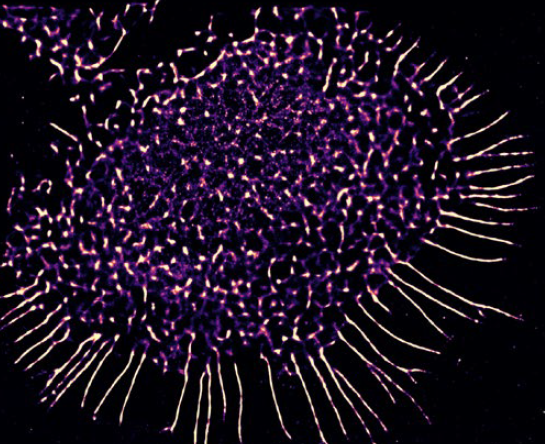
The photonic chip that illuminates the cell
The chip makes it possible to observe cellular details and dynamics that conventional optics cannot distinguish. It supports predictive assessments and actions. Experimental tests in Germany confirmed the reliability and quality of the results. Possible applications include immunology, advanced diagnostics and biomedical microscopy. Francesco Dell’Olio, a lecturer at Poliba, is one of the study’s authors. He says: “the result highlights a line of research in integrated photonics developed at our university. We now want to establish collaborations with hospitals, IRCCS institutes, universities and local research centres in order to apply the platform to concrete biological and pharmacological questions”
1 August 2026
Miniaturized integrated photonics technology has enabled new advances in knowledge, which have in turn led to applications. Technology that uses light instead of electricity has produced photonic chips capable of extending researchers’ view of the cellular world and enabling new discoveries.
The photonic chip, at the heart of this innovation, is a miniaturized circuit that, instead of electric current, guides and controls light through extremely thin pathways that work like microscopic roads for light: they can carry, split, combine, filter or direct it towards specific points.

In the study, the photonic chip is used to illuminate cells selectively and obtain highly detailed images of their internal structures. The work demonstrates that a transparent photonic chip can be used not only as a support for the biological sample, but also as a fully fledged device for advanced optical microscopy. This makes it possible to observe nanometre-scale details that conventional optical microscopy cannot distinguish. The photonic chip thus proves to be an integrated optical platform capable of making analytical instruments more compact and precise, and potentially suitable for examining many cells.
“Science Advances”. All this is part of a scientific study entitled, “Photonic waveguide chip-based nanoscopy visualizes rearrangements of the cortical actin cytoskeleton in activated Jurkat T cells”, published on 15 July in the international scientific journal “Science Advances”.
Authors The authors of the article are a group of researchers from three academic institutions: Bielefeld University (Germany), responsible for the biological and experimental component; Aschaffenburg University of Applied Sciences (Germany), responsible for the platform, development and production of transparent chips; and the Polytechnic University of Bari (Italy), responsible for the research concept, methodological development of the photonic platform, and data management and validation. The coordinator and scientific lead for Poliba is Professor Francesco Dell’Olio of the Department of Electrical and Information Engineering.


The experimental study has focused primarily on T lymphocytes, the white blood cells that fight infections and diseased cells. When a T lymphocyte becomes activated, it rapidly reorganises its internal “scaffolding”, composed largely of actin filaments, to form what is known as the immunological synapse: the contact area through which the cell recognises and responds to a target. This innovation makes it possible to visualise this reorganisation at very high resolution and across a wide field of view.
Applications. In the short term, the impact will be felt in biological and pharmacological research. In oncology, this technology could help improve immunotherapies. T lymphocytes, including CAR-T cells modified in the laboratory, can eliminate tumour cells by forming an “immunological synapse” with them—a contact area in which the actin network reorganises. Observing this process at the nanoscale could make it possible to compare cells with differing efficacy, understand why some fail to attack the tumour, and assess the effects of drugs or new genetic modifications. The photonic chip could become a research tool for designing more targeted and effective immunotherapies in the future.
Comments. “For the Polytechnic University of Bari – says Professor Francesco Dell’Olio – the news highlights a line of research in integrated photonics developed by the Department of Electrical and Information Engineering at our university. The publication provides a valuable opportunity to showcase Poliba’s ability to contribute to enabling technologies for the study of complex cellular processes, with potential future applications in immunology, advanced diagnostics and biomedical microscopy. This result is a starting point. We aim to establish collaborations with hospitals, IRCCS institutes, universities and local research centres to apply the platform to concrete biological and pharmacological questions. It is not enough to see smaller structures: this capability must be translated into useful information for those who study cells, drugs and immune responses.”
The article The photonic chip that illuminates the cell comes from Poliba Chronicle.