Department of Electrical and Information Engineering
Groups and Committees
Department Council
Timetabling Committee
Profile
Biography
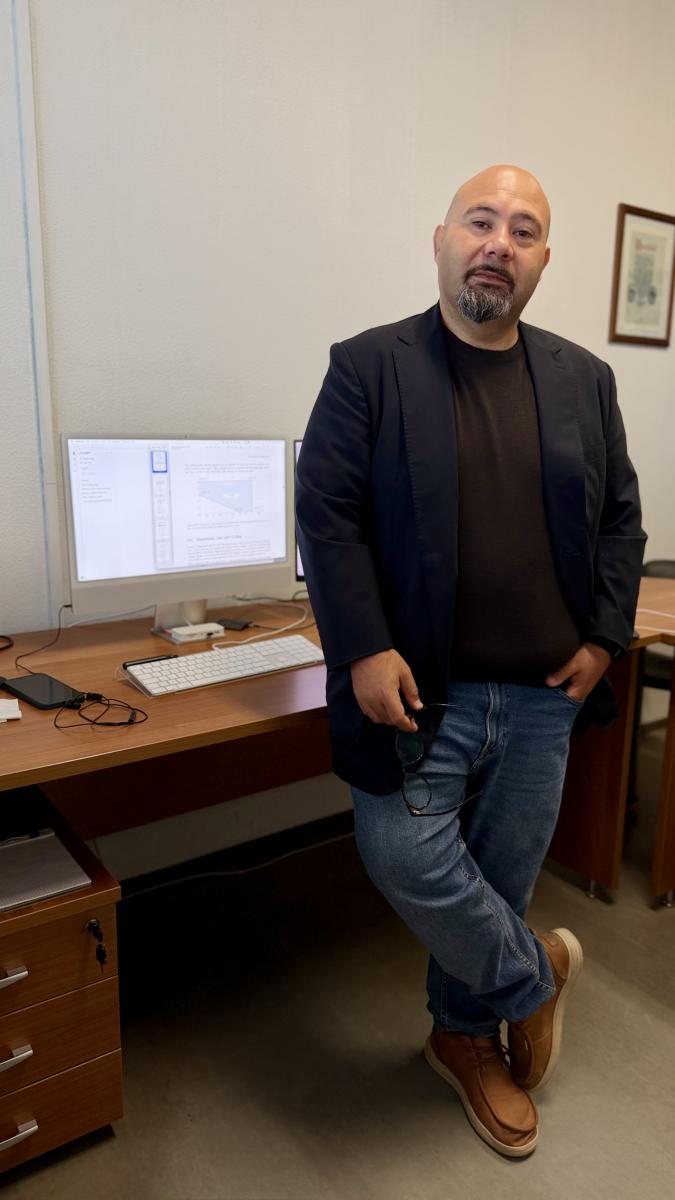
Alessandro Coclite is a lecturer in Numerical Analysis at the Polytechnic University of Bari. He earned a master’s degree in Theoretical Physics from the University of Bari in September 2011 and a PhD in Mechanical and Management Engineering from the Polytechnic University of Bari in March 2015. He subsequently held postdoctoral research positions at the Italian Institute of Technology in Genoa, the University of Bristol, and the University of Basilicata. Since December 2020, he has been employed at the Polytechnic University of Bari, where he conducts research and teaches in numerical analysis and computational modelling. His research focuses on the development, analysis, and implementation of numerical methods for partial differential equations and multiphysics problems, with particular emphasis on computational fluid dynamics, fluid–structure interaction, multiphase flows, and microfluidics. He has also worked on nonlocal and peridynamic models, Lattice Boltzmann and Immersed Boundary methods, transport and adhesion in the microcirculation, and biomedical applications. More recently, his interests have expanded to numerical methods on nonconforming domains, network models, and machine-learning techniques for preconditioning and efficiently solving parametrised linear systems.
Scientific-disciplinary sector
MATH-05/A
Expertise
Settori ERC
PE1Mathematics: All areas of mathematics, pure and applied, plus mathematical foundations of computer science, mathematical physics and statistics
Curriculum
Alessandro Coclite’s research lies in numerical analysis, mathematical modelling, and scientific computing, with particular focus on the design, analysis, and implementation of numerical methods for partial differential equations, multiphysics problems, and nonlocal models. His research is characterised by a strongly interdisciplinary approach, in which numerical analysis and computational simulation tools are developed in connection with problems of physical, engineering, and biomedical interest.
One of his main research areas concerns computational fluid dynamics and the simulation of complex systems involving interactions between fluids, deformable structures, and immersed particles. In this context, his work has included the development and use of Lattice Boltzmann and Immersed Boundary methods to simulate multiphase flows, fluid–structure interactions, and transport phenomena in complex geometries. Particular attention has been given to microfluidic and biomedical applications, such as the dynamics of cells and particles in the microcirculation, wall-adhesion processes, and the modelling of transport in vascular and tumour environments. These studies integrate physical modelling, numerical discretisation, and high-performance simulation, with the aim of describing phenomena in which different spatial and temporal scales are strongly coupled.
A second research strand concerns nonlocal models and peridynamics. Scientific activity in this area has focused on formulating nonlocal integral models and developing numerical methods for their approximation, including on curved domains and two-dimensional manifolds. A significant component of this research is devoted to studying the consistency of discretizations, the relationship between nonlocal formulations and classical differential models, and the development of computational techniques capable of preserving the structural properties of the continuous problem. More broadly, these topics are part of the study of nonlocal and fractional operators and their numerical approximation.
More recently, this work has expanded to the development of numerical methods for problems defined on complex geometries, non-conforming domains, and network structures, with particular attention to formulations that are robust with respect to geometry and suitable for efficient implementation. This framework also encompasses the study of models and methods for problems defined on networks and graphs, where the discrete structure of the domain interacts with the dynamics described by differential equations.
A more recent research direction also concerns the integration of classical numerical methods with machine learning techniques. Particular interest lies in developing data-driven strategies for preconditioning and accelerating the solution of parameterized linear systems arising from the discretization of partial differential equations. The aim is to use machine learning techniques not as replacements for traditional numerical solvers, but as tools integrated into scientific algorithms, while maintaining control over accuracy, stability, and computational efficiency.
Overall, this scientific activity is united by an interest in developing rigorous and computationally efficient numerical methodologies for problems characterized by geometric, multiscale, or multiphysics complexity. The approach combines mathematical formulation, analysis of numerical properties, algorithmic implementation, and computational validation, with particular attention to the transferability of methodologies across different classes of application problems.
Teaching
Office hours
Friday 15:00-18:00 (Office hours are held in the lecturer’s office (third floor, Salvatore building) by appointment.)
Courses
METODI DI OTTIMIZZAZIONE[2132]
MANAGEMENT ENGINEERINGBachelor's Degree Programme
CURRICULUM INDUSTRIALEYear: 1 · Cohort: 2025
CURRICULUM INFORMAZIONEYear: 1 · Cohort: 2025
CURRICULUM INFRASTRUTTUREYear: 1 · Cohort: 2025
PERCORSO COMUNEYear: 1 · Cohort: 2025
CALCOLO NUMERICO[2171]
ELECTRONIC ENGINEERING AND INTERNET TECHNOLOGIESBachelor's Degree Programme
MUNICIPALITYYear: 1 · Cohort: 2025
ELECTRONICSYear: 1 · Cohort: 2025
TECNOLOGIE INTERNETYear: 1 · Cohort: 2025
COMPUTER AND AUTOMATION ENGINEERING (Ministerial Decree 270/04)Bachelor's Degree Programme
PERCORSO P-TECHOther activities · Cohort: 2023
AEROSPACE SYSTEMS ENGINEERINGBachelor's Degree Programme
L8 COMUNE CURRICULUMOther activities · Cohort: 2025
Publications
38Publications
377Citations
2013 - 2026Output
Output by year
Main categories
38 publications
All publications
Page 1 of 4
2026A cascaded-entropic lattice Boltzmann method for wettability control on off-grid surfaces via coupled boundary-force interpolationArticolo in rivista | Marco Desiderio LOFFREDO SENESI; Alessandro Coclite; Ingenuin Gasser; Michele Dassisti | COMPUTERS & MATHEMATICS WITH APPLICATIONS
Open to view all details.
2025Neural preconditioning via Krylov subspace geometryJournal article | Alessandro Coclite; Alessandro Coclite | BULLETIN OF THE ITALIAN MATHEMATICAL UNION
2025A replicator model with transport dynamics on networks for species evolutionArticolo in rivista | Alessandro Coclite; Sabrina Francesca Pellegrino; Tiziano Politi; Marina Popolizio | JOURNAL OF MATHEMATICAL BIOLOGY
Open to view all details.
2025On the effect of force isotropy in a multiphase cascaded lattice Boltzmann scheme with entropic stabilizationArticolo in rivista | Marco Desiderio LOFFREDO SENESI; Alessandro Coclite; Michele Dassisti | COMPUTERS & MATHEMATICS WITH APPLICATIONS
Open to view all details.
2025A spectral method for dispersive solutions of the nonlocal Sine–Gordon equationArticolo in rivista | Alessandro Coclite; Sabrina Francesca Pellegrino | MATHEMATICS AND COMPUTERS IN SIMULATION
2024Numerical Approaches for Multiphase MicrofluidsContribution to a volume (Chapter or Essay) | Alessandro Coclite; Francesco De Vita
Open to view all details.
2024A Numerical Framework for Nonlinear Peridynamics on Two-Dimensional Manifolds Based on Implicit P-(EC)k SchemesJournal article | Alessandro Coclite; Giuseppe Maria Coclite; Francesco Maddalena; Tiziano Politi | SIAM JOURNAL ON NUMERICAL ANALYSIS
2024A fluid-structure interaction method for soft particle transport in curved microchannelsArticolo in rivista | Dario De Marinis; Alberto Mantegazza; Alessandro Coclite; Marco Donato De Tullio | COMPUTER METHODS IN APPLIED MECHANICS AND ENGINEERING
2023Dispersive Effects in Two- and Three-Dimensional PeridynamicsJournal article | Alessandro Coclite; Giuseppe Maria Coclite; Francesco Maddalena | ACTA APPLICANDAE MATHEMATICAE
Open to view all details.
About
We are professional and reliable provider since we offer customers the most powerful and beautiful themes. Besides, we always catch the latest technology and adapt to follow world’s new trends to deliver the best themes to the market.